



Dropout Early-Warning System For ITIs & Polytechnics
Attendance, assessments and engagement feed one explainable AI model, so every trainee who starts to slip gets help in time.
Book A Demo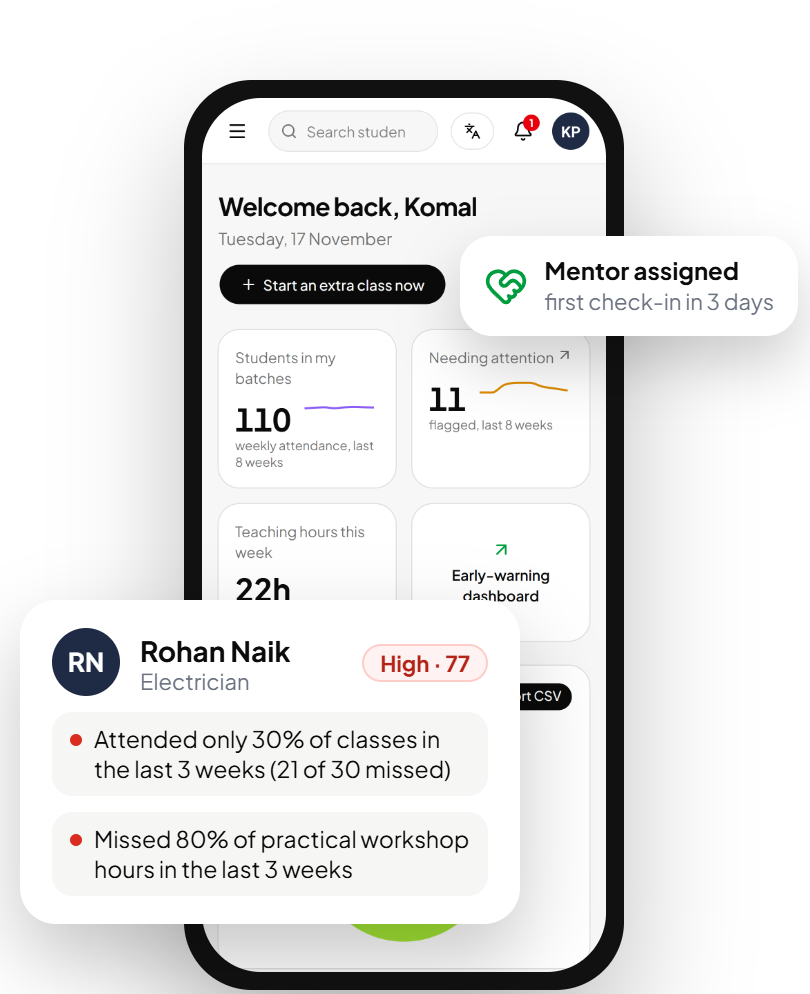






QR Attendance With Anti-Proxy Checks

Explainable Risk Scores
Human-in-the-Loop Interventions
Personalised Learning Paths
Faculty Workload Optimiser
Guardian Alerts in English, Hindi & Konkani
Privacy by Design
- Early Warning & Support
- Learning & Resources
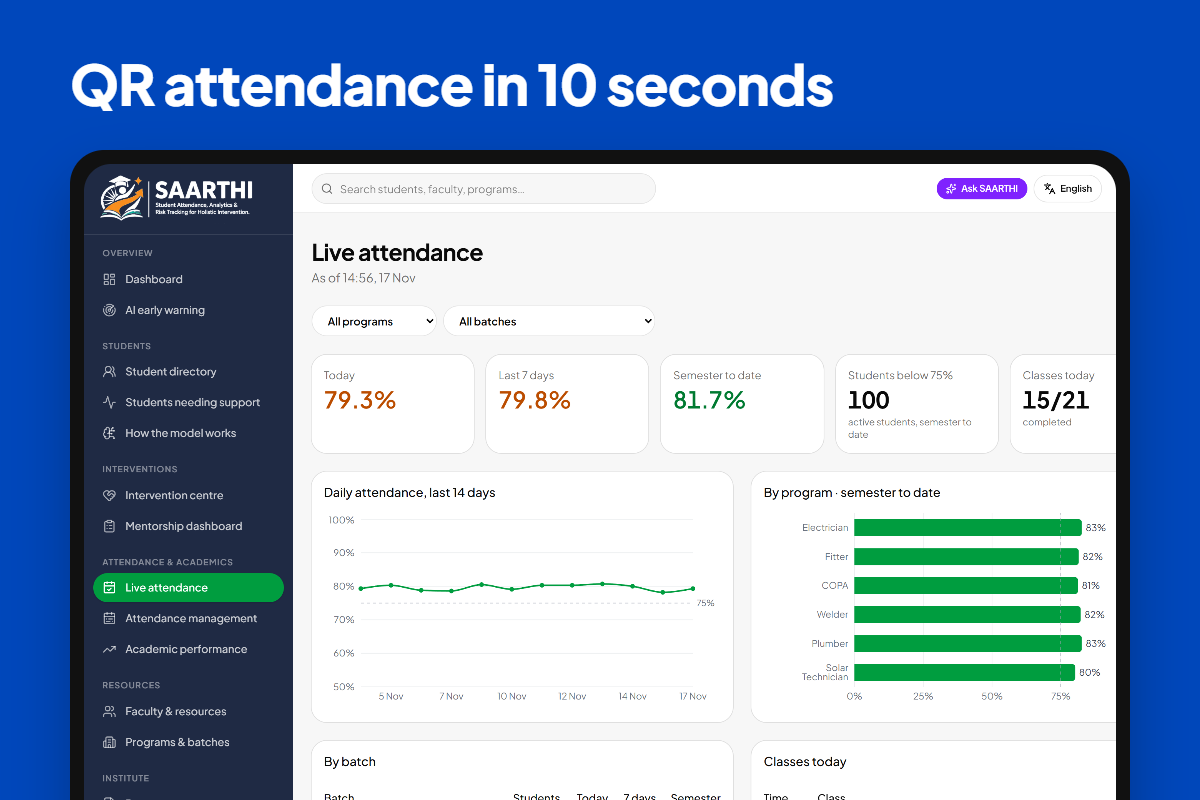
QR Attendance & Live Class Dashboards
Instructors open a rotating QR code and trainees check in from any phone browser in seconds. Codes expire and each trainee can scan once, so proxies don't work. Class, batch and program dashboards update live, and every manual correction is logged with a reason.
Live sync

Explainable Dropout Risk For Every Trainee
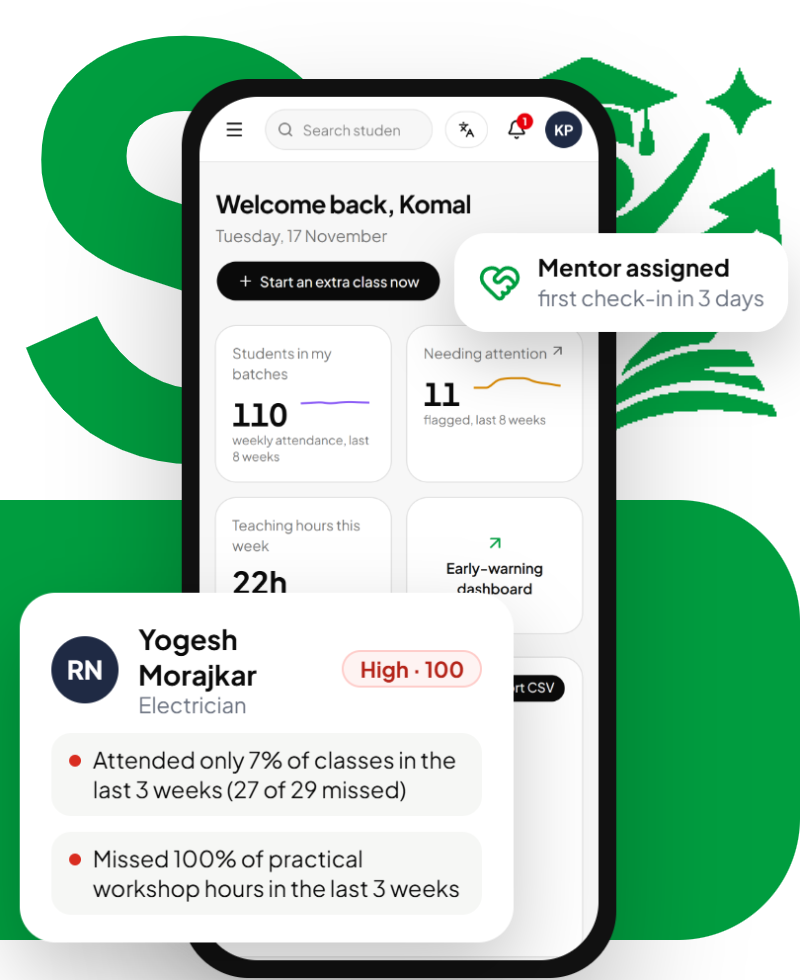
A calibrated model reads attendance trends, absence streaks, marks, practical-theory gaps and learning activity every night. Each trainee gets a 0–100 score, a Low, Medium or High band and the top three reasons in plain language.
Explainable AI

Intervention Workflow From Flag To Follow-Through
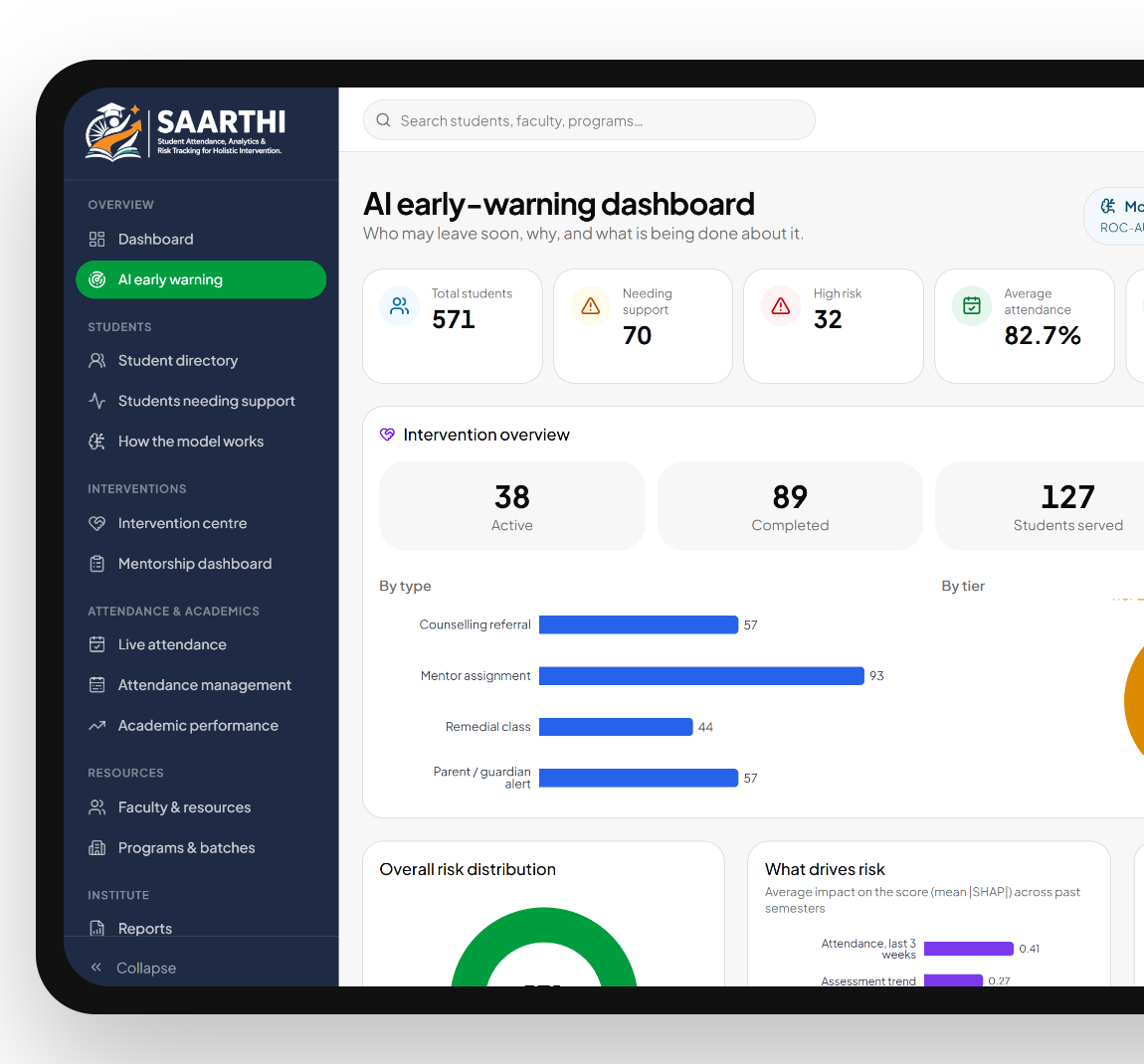
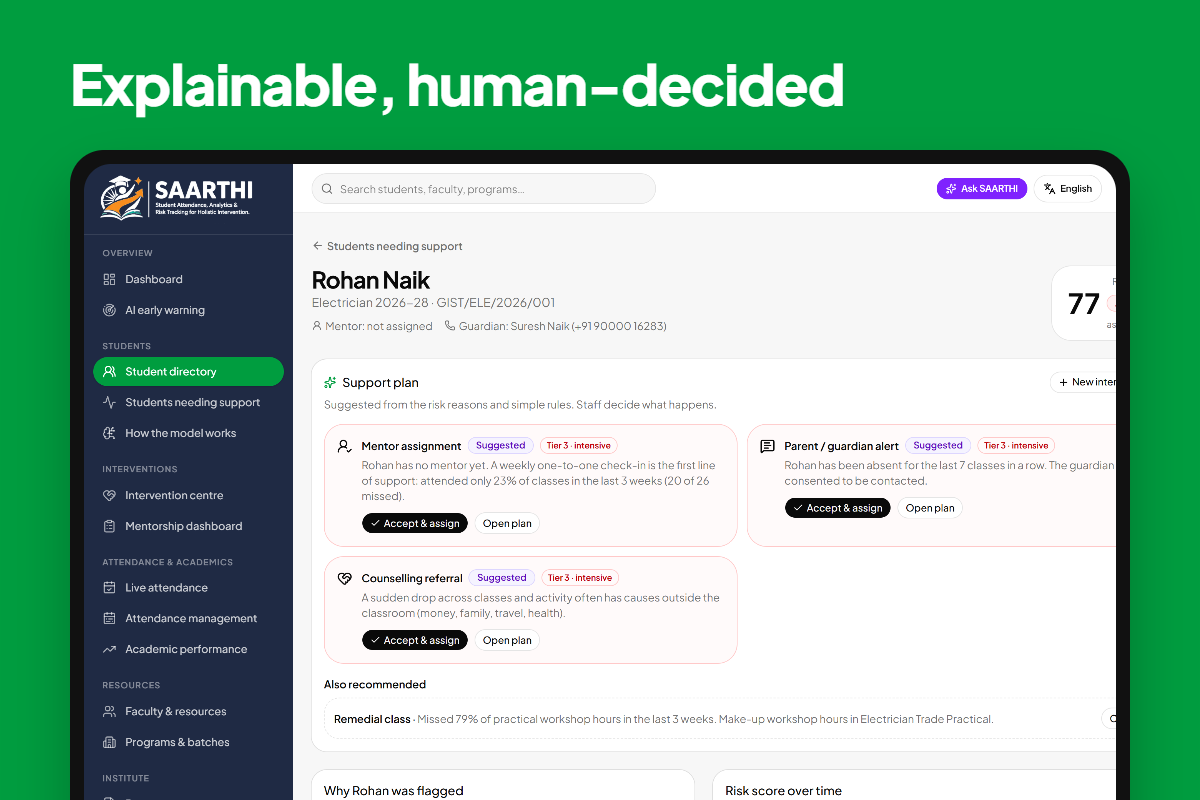
SAARTHI suggests a mentor, a remedial class, a guardian call or a counselling referral. Staff decide, assign and track follow-ups; nothing happens automatically and nothing is punitive.
Human-decided

Guardian Alerts, In Their Language
With the trainee's consent, instructors send WhatsApp or email messages in English, Hindi or Konkani, drafted from the actual attendance and reasons. Every message is logged on the trainee's plan.
Consent-first

Personalised Skill Maps & Learning Paths
Assessment results become a competency map for each trainee. The weakest skills come first in a recommended path of trade-specific lessons, practice checks and an AI study coach.
Smart AI

Performance Monitoring & Cohort Comparison
Theory, practical and assignment marks roll up into subject trends, pass rates and batch comparisons, so instructors see where a whole class needs help, not just one trainee.
Live analytics

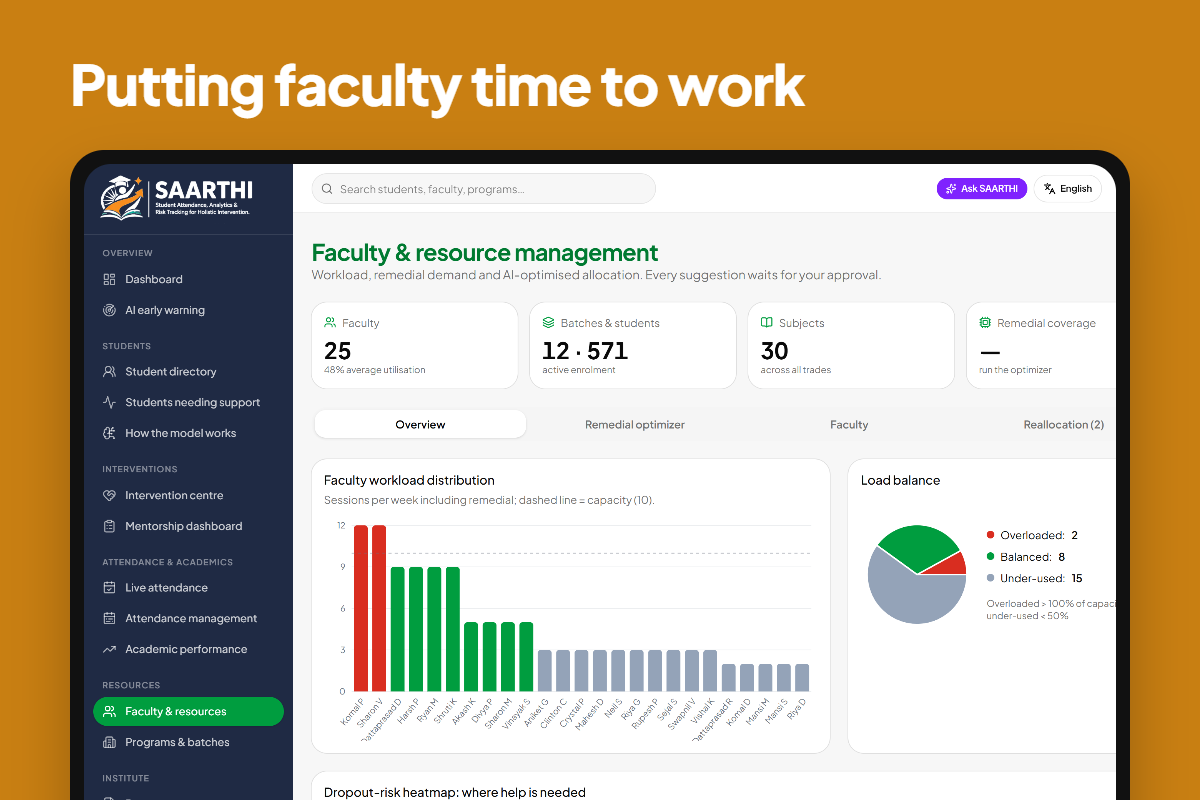
Intelligent Faculty & Remedial Planning
See overloaded and under-used instructors, then let the optimiser propose remedial slots and faculty assignments based on how many trainees need help in each subject.
Optimiser

Reports & An Assistant For Every Question
Download attendance, performance, risk and program reports as PDF, Excel or CSV, or ask SAARTHI in plain words who needs attention this week.
AI assists

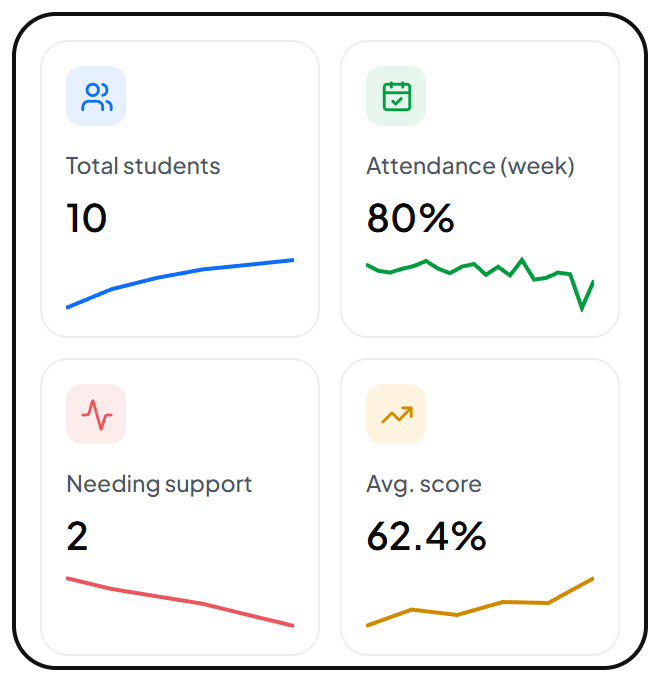
Instructors open a rotating QR code and trainees check in from any phone browser in seconds. Codes expire and each trainee can scan once, so proxies don't work. Class, batch and program dashboards update live, and every manual correction is logged with a reason.
A calibrated model reads attendance trends, absence streaks, marks, practical-theory gaps and learning activity every night. Each trainee gets a 0–100 score, a Low, Medium or High band and the top three reasons in plain language.
SAARTHI suggests a mentor, a remedial class, a guardian call or a counselling referral. Staff decide, assign and track follow-ups; nothing happens automatically and nothing is punitive.
With the trainee's consent, instructors send WhatsApp or email messages in English, Hindi or Konkani, drafted from the actual attendance and reasons. Every message is logged on the trainee's plan.
Assessment results become a competency map for each trainee. The weakest skills come first in a recommended path of trade-specific lessons, practice checks and an AI study coach.
Theory, practical and assignment marks roll up into subject trends, pass rates and batch comparisons, so instructors see where a whole class needs help, not just one trainee.
See overloaded and under-used instructors, then let the optimiser propose remedial slots and faculty assignments based on how many trainees need help in each subject.
Download attendance, performance, risk and program reports as PDF, Excel or CSV, or ask SAARTHI in plain words who needs attention this week.
Simplifying Every Step From Flag To Follow-Through
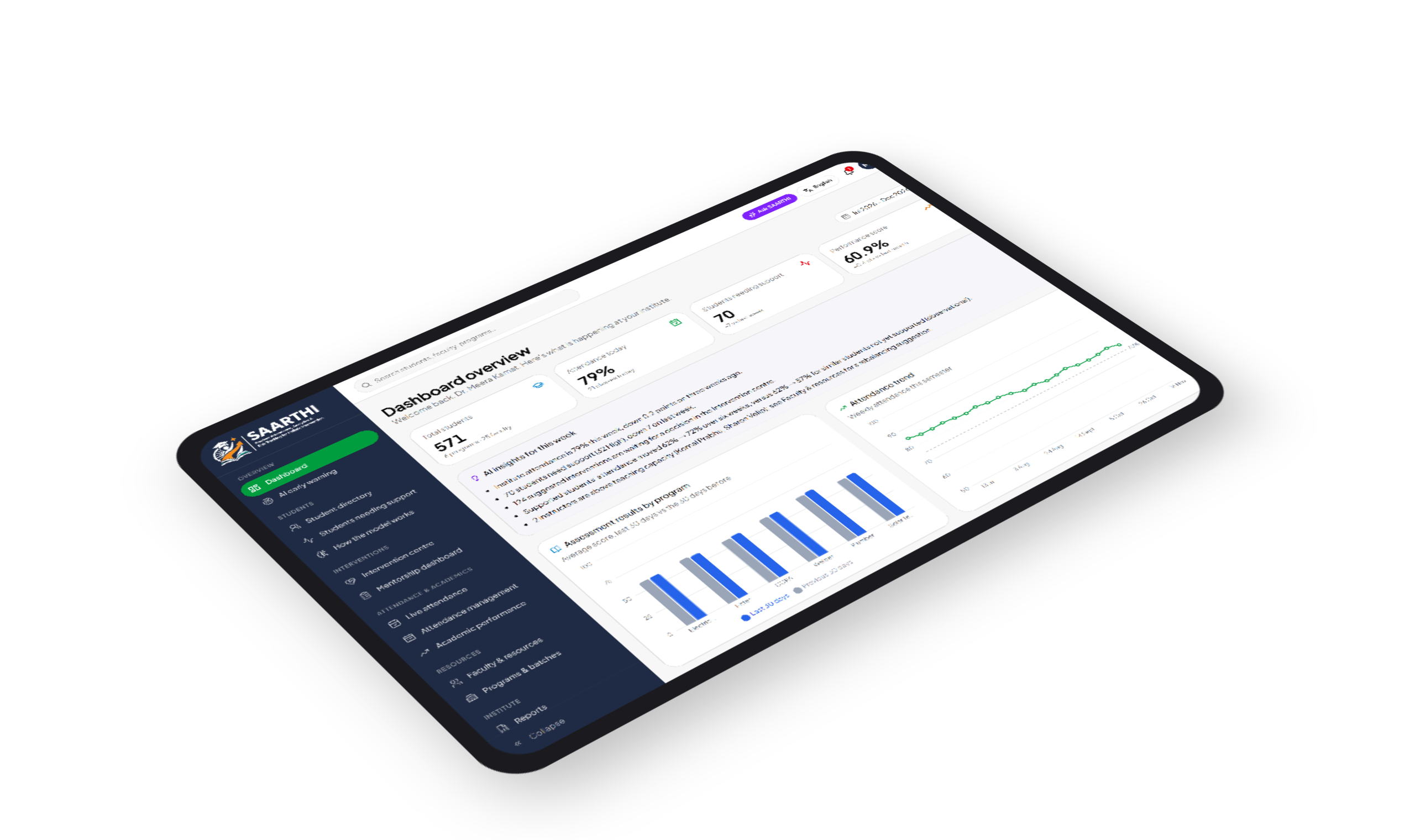
SAARTHI connects attendance, assessments and support in one platform for your institute. Principals see institute-wide risk, instructors see their own batches, and trainees see kind, encouraging progress. Every flag is explained, every action is decided by a person, and every outcome is measured.

Built To Connect
SAARTHI works with what institutes already use: QR check-in from any phone browser, WhatsApp and email guardian alerts, Excel, CSV and PDF exports, CSV import for onboarding and a built-in AI assistant. Connectors for NCVT MIS and Skill India Digital are planned for the pilot.


Smarter Support For Every Trainee
Know Who Is Slipping, Early
Attendance, marks, practical hours and learning activity are combined every night into one risk score per trainee, with the top three reasons written in plain language, weeks before a dropout would show up in the register.
Act Together, Not Alone
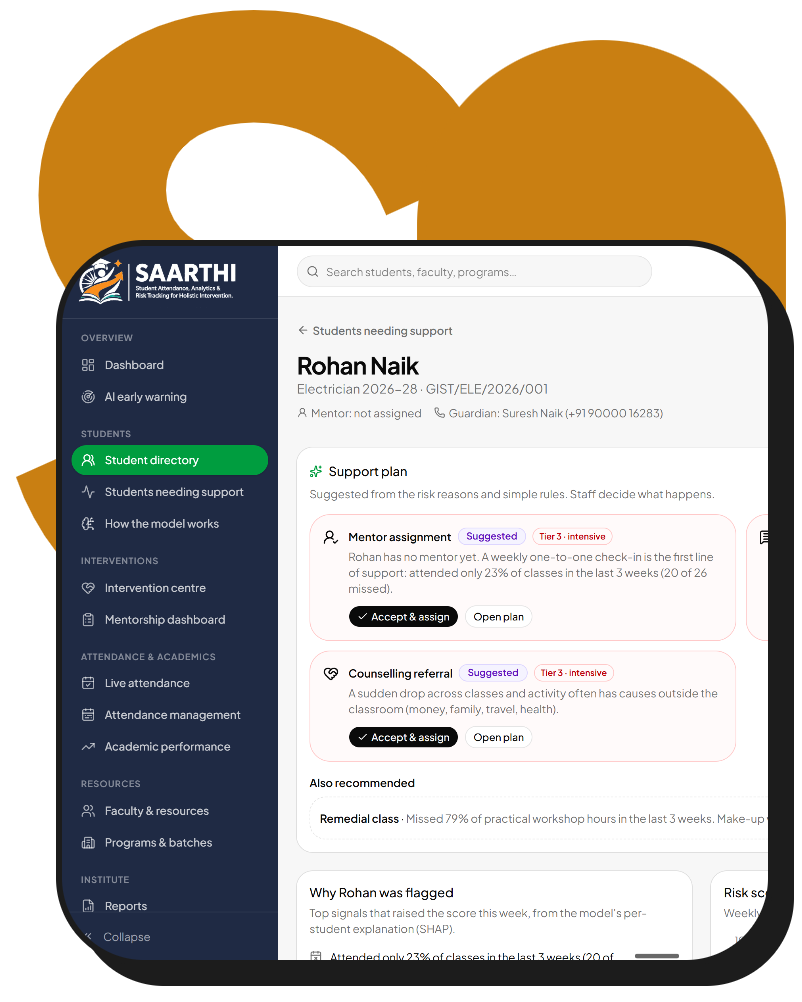
Turn a flag into a mentor, a remedial class, a guardian call or a counselling referral. Staff decide, assign owners, track follow-ups and keep notes on one shared plan.
Measure What Actually Helps
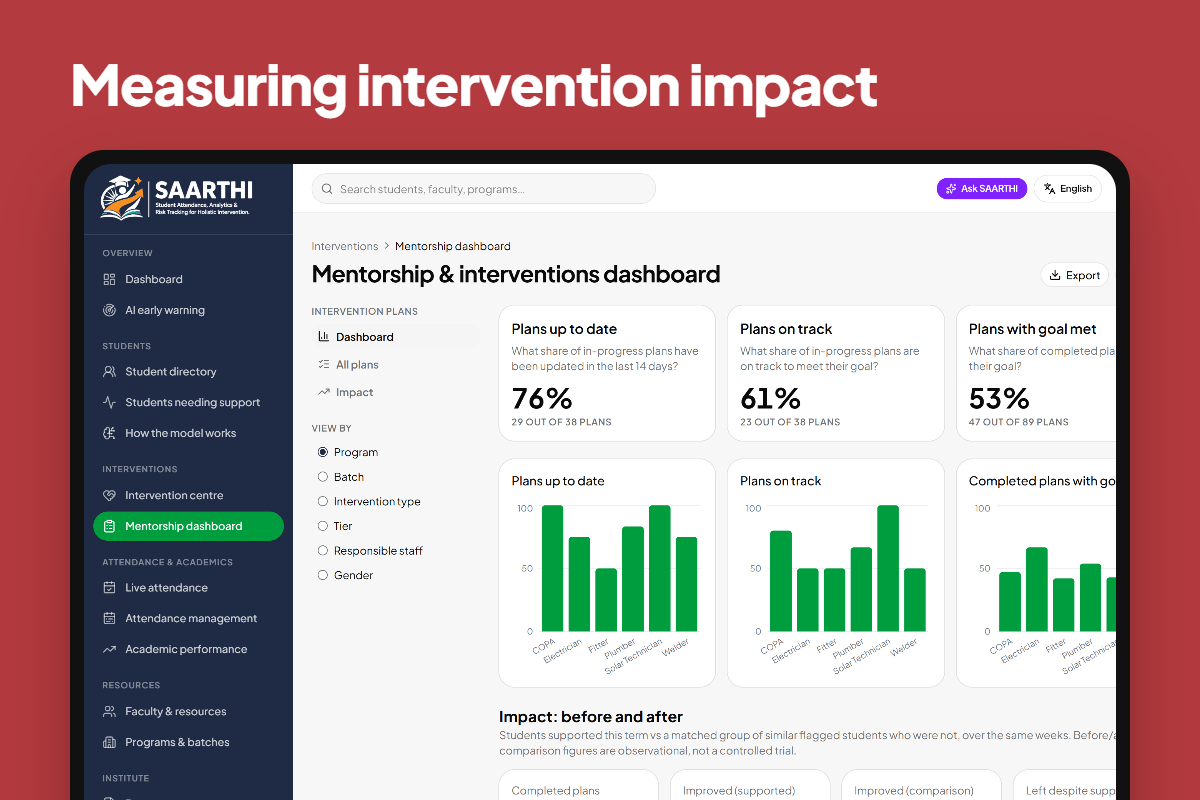
Before-and-after attendance and risk, compared with similar trainees not yet supported, show which kinds of support work, so faculty time goes where it changes outcomes.
Why Institutes Can Trust SAARTHI
Built for how vocational institutes actually work: trades, workshops, practical hours and trade-test eligibility. SAARTHI is explainable, human-decided and light enough to run on a single small server.

Explainable By Design
Every Flag Comes With Its Reasons
- Staff see the top three reasons behind each score, like “attendance dropped 28% in the last 3 weeks”.
- Model accuracy, calibration and fairness checks are published on a model card inside the app.

People Decide, Always
No Automated Punitive Action
- A risk score only suggests supportive steps; instructors and principals decide what happens.
- Trainees never see a risk label, only encouraging, practical next steps.

Built For Vocational Training
Trades, Workshops And Trade-Test Eligibility
- Practical-hour gaps, workshop attendance and the 75% trade-test rule are first-class signals.
- Synthetic data covers Electrician, Fitter, COPA, Welder, Plumber and Solar Technician trades.

Private And Light To Run
Role-Based Access, Consent And Low Bandwidth
- Instructors see only their batches; guardian contact needs the trainee's consent; every action is audited.
- Works in a phone browser on patchy networks, with nothing to install.
How SAARTHI Supports Everyone On Campus
SAARTHI for
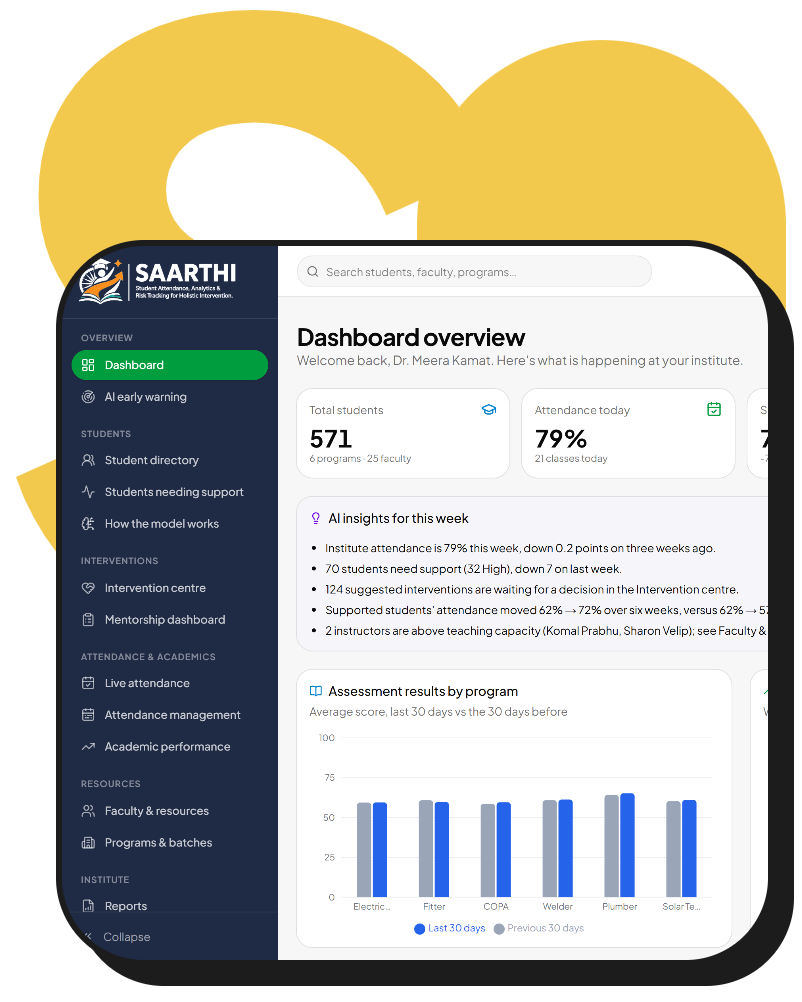
Principals & Admins
Institute At A Glance
Students, attendance, risk and results on one dashboard.
Dropout Risk Heatmap
See which programs and batches need attention first.
Proof Of Impact
Before-and-after attendance and risk for supported trainees.
Smarter Allocation
Rebalance faculty load and plan remedial classes.
Reports In One Click
PDF, Excel and CSV reports for reviews and audits.
SAARTHI for
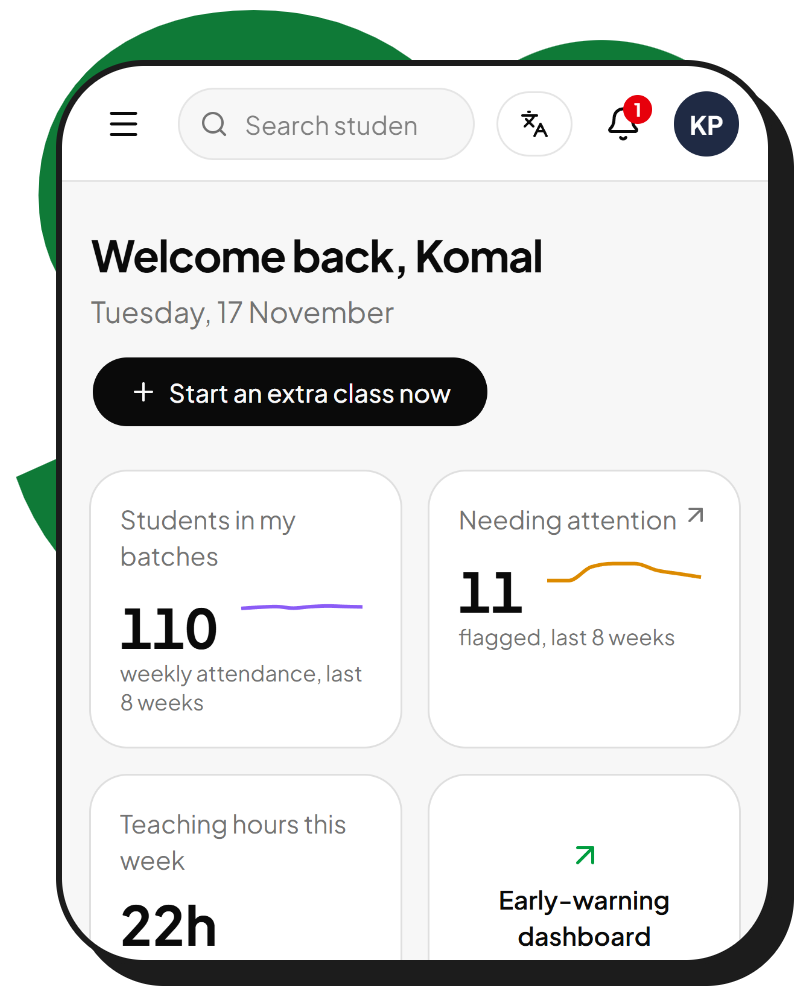
Instructors
Ten-Second Check-In
Open a rotating QR code and watch the class fill in live.
Who To Watch
Trainees in your batches who are slipping, and why.
Suggested Next Steps
Mentoring, remedial practice or a guardian call, your choice.
Marks & Skill Rubrics
Theory and practical marks feed each trainee's skill map.
Less Paperwork
Corrections, notes and follow-ups in one place.
SAARTHI for
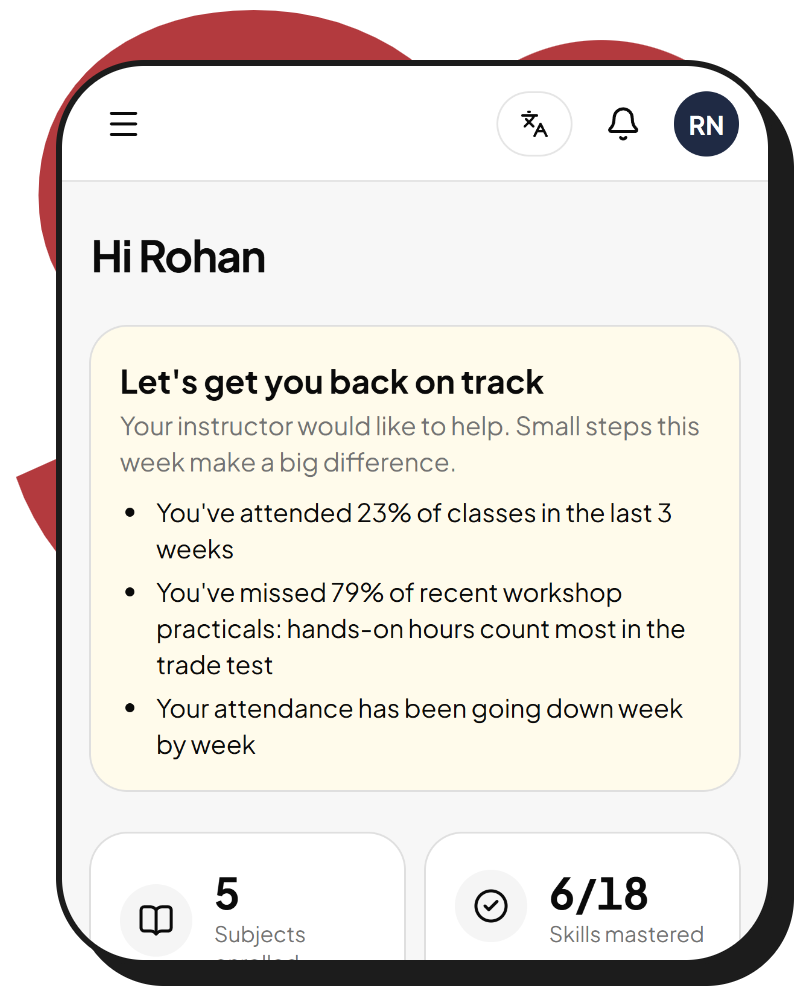
Trainees
Kind Progress Updates
Encouraging, practical messages, never a risk label.
My Learning Path
Lessons and practice for your weakest skills first.
Study Coach
Ask questions about your trade, any time.
My Attendance Target
How many classes you need for the 75% trade-test rule.
My Mentor
Know who is helping you and what you agreed.
SAARTHI for
Guardians
Timely Alerts
A message when attendance starts to slip, not at term end.
In Their Language
WhatsApp or email in English, Hindi or Konkani.
Consent First
Only with the trainee's permission, and every message is logged.
A Named Contact
Messages come from the trainee's own instructor or mentor.
Part Of The Plan
Calls and agreements are recorded on the support plan.
Built Around The People Who Use It

Frequently Asked Questions (FAQs)
General & Value
What is SAARTHI and who is it for?
SAARTHI (Student Attendance, Analytics & Risk Tracking for Holistic Intervention) is an early-warning and support platform for ITIs, polytechnics and skill centres. It joins attendance, assessments and learning activity, flags trainees who may drop out, explains why, and helps staff act.
What does SAARTHI actually change for an institute?
Staff find out who is slipping weeks earlier, with reasons they can check. Suggested support (mentoring, remedial classes, guardian calls, counselling) is tracked to an outcome, and the impact view shows what worked.
Is this a full ERP?
No. SAARTHI focuses on student success: attendance, performance, risk, interventions, learning paths and faculty allocation. It is designed to sit next to existing admission and fee systems and exchange data with them.
Risk Model & Fairness
How does the dropout risk model work?
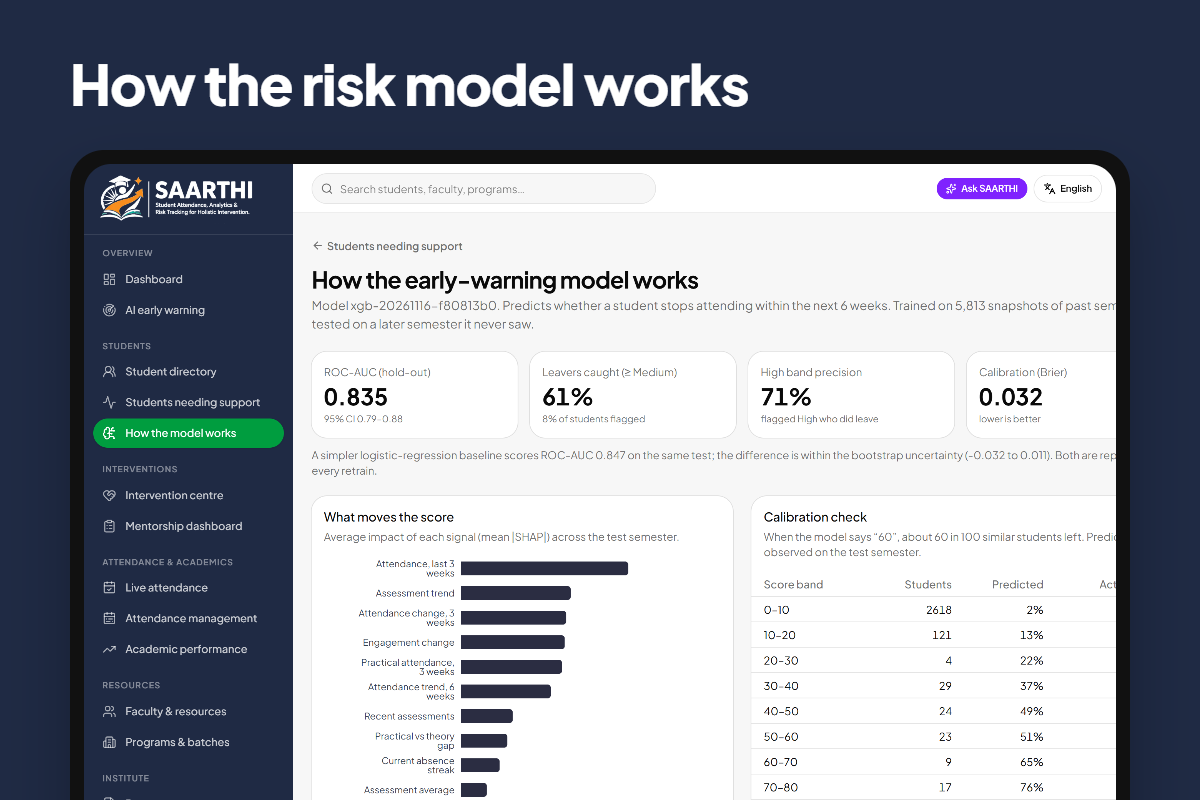
A gradient-boosting model (XGBoost) with calibrated probabilities reads 17 behavioural signals such as attendance trend, absence streaks, marks, practical-theory gap and engagement. Each trainee gets a 0–100 score, a band and the top three reasons from SHAP explanations.
How accurate is it?
On held-out synthetic cohorts the model reaches a ROC-AUC of about 0.84, and at the Medium threshold it flags about 61% of trainees who later leave. A simpler baseline is reported alongside it. Real performance must be re-measured on an institute's own history before rollout.
Can the model be biased?
Inputs are behavioural only; gender, caste, income and commute are never used to score. They are used only to audit recall gaps between groups, and the gaps are published on the model card.
Does a High risk score lead to any penalty?
Never. A score only suggests supportive steps. A person decides what happens, and trainees see encouraging messages, not risk labels.
Attendance & Daily Use
How does QR attendance stop proxies?
Each class shows a rotating QR code that expires in seconds, each trainee can check in only once per class, and the device is recorded as a one-way hash. Instructors can correct any mark, with a reason that is logged.
Will it work on poor connections and basic phones?
Yes. Check-in is a light web page that works in any phone browser, with nothing to install, and dashboards are designed to load quickly on slow networks.
Will instructors have to do more work?
Less. Attendance takes seconds, flagged trainees arrive with suggested next steps, and follow-ups and notes live in one place instead of registers and phone calls.
Privacy & Data
Who can see a trainee's data?
Access is role-based: instructors see only the batches they teach or mentor, trainees see only their own records, and every status change, message and export is written to an audit log.
How are guardians contacted?
Only if the trainee has consented and the institute has guardian messaging switched on. Messages are drafted from real attendance in English, Hindi or Konkani and logged. In this prototype they are simulated, never sent.
Is the demo using real student data?
No. Every person in the demo is synthetic; emails use a reserved test domain that can never reach a real inbox.
Rollout & Integration
How would an institute get started?
Import trainees and faculty from CSV (checked row by row before anything is saved), set the semester and alert thresholds, and start QR attendance. Risk scores begin once a few weeks of data exist.
Can it connect to government portals?
Exports are available today as CSV, Excel and PDF. Connectors for NCVT MIS and Skill India Digital are planned for the pilot, starting with one institute, then a district, then the state.
Where does it run, and what does it cost?
It runs on a single small server or in containers (Docker), with SQLite for a pilot and PostgreSQL at scale. AI features (the study coach and staff assistant) use a hosted AI model when an API key is configured; without one, built-in rules answer.